Julio J. Candanedo

I am an AI scintist at SparseTrace.ai. Prior, I was a postdoctoral researcher in the Department of Physics at University of Wisconsin-Milwaukee. I received my Ph.D. in 2023 from the Department of Physics at Arizona State University, advised by Professor John C.H. Spence, Oliver Beckstein, and Christian Arenz. My research lies broadly at the intersection of Physics and AI, with a current focus on physical chemistry, manifold learning, autoregressive generative models, and diffusion models.

Papers

Thumbnail for Paper 1

Linearized Diffusion Map

J. Candanedo · arXiv (2025)

arXiv code project page

We introduce the Linearized Diffusion Map (LDM), a novel linear dimensionality reduction method constructed via a linear approximation of the diffusion-map kernel. LDM integrates the geometric intuition of diffusion-based nonlinear methods with the computational simplicity, efficiency, and interpretability inherent in linear embeddings such as PCA and classical MDS.
Thumbnail for Paper 2

E(3) Invariant Representations of Biomolecules

J. Candanedo · bioRxiv preprint (2025)

bioRxiv

We present a coordinate-independent method for encoding protein structures using anchor-point-based trilateration that respects Euclidean symmetry while avoiding O(N^2) scaling problems of distance matrices. Our approach achieves near-perfect reconstruction of protein structures, and when combined with dimensionality reduction techniques, effectively captures conformational dynamics in molecular trajectories.

Thumbnail for Paper 3

Diffusion Map Autoencoder

J. Candanedo · arXiv preprint (2024)

arXiv

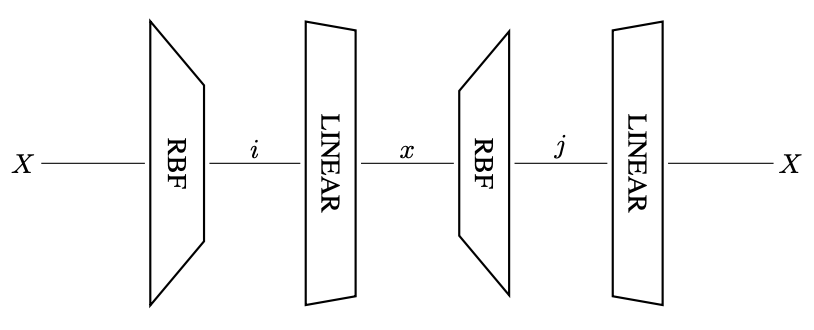
Diffusion-Map-AutoEncoder (DMAE) pairs a diffusion-map encoder (using the Nyström method) with linear or RBF Gaussian-Process latent mean decoders, yielding closed-form inductive mappings and strong reconstructions.

Thumbnail for Paper 4

notes on Generalized Configuration-Interaction in python

J. Candanedo · chemRxiv preprint (2023)

chemRxiv

In this work we construct a detailed understanding of the distribution of electrons as described by the Full-Configuration-Interaction (FCI) and for a generalized active-space. These results are presented at an introductory level for beginning practitioners or non-experts. Suitable background are a knowledge of linear-algebra and basic NumPy and Python principles of array manipulation.